Author: allanah-davies

  • Among Dirt and Diamonds at Miu Miu

    Among Dirt and Diamonds at Miu Miu

    By Allanah Davies

    For the final show on the Paris Fashion Week calendar, Miuccia Prada digs her hands into the soil, and, apparently, strikes gemstones. Miu Miu’s FW26 collection, Mindful Intimacy, zooms in on what Prada described as “the smallness of our human bodies in the vastness of our world.” Across the sixty-six-look collection, she positions clothing as a form of self-preservation: a way to honour and protect individuality amid both natural and social chaos. Through the interplay of simple cotton smocks and enchanting, bedazzled embellishments, Prada once again breathes life into the ‘little sister’ spirit that defines Miu Miu. In doing so, she uses the collection to emphasise precisely that idea: to “give value to our small bodies.”

    Prada establishes a physical, almost kinetic dialogue between her garments and the natural world. Watch as blue, jewel-encrusted slide-in sandals kick up clouds of dirt beneath each step, or as a leather skirt suit worn by Chloë Sevignyappears almost dipped in animal fur. Yet the body interacts with the more fantastical design elements in much the same way. While some looks arrive stripped back, embellishment remains central throughout the collection. From shoestring-thin bows peeking through suit chests in the opening looks to sequin panels on sheer flapper dresses worn by Gemma Ward and Gillian Anderson, Prada “valorises the body” through both natural immersion and handcrafted precision.

    The opening look appears deceptively simple when viewed head-on. A black suit is cinched just beneath the bust with a tied belt, paired with elongated straight-leg trousers marked by a sharp front crease. Atop the model’s head sits a shearling trapper hat, its natural fur framing the face with practical warmth. Yet as the model turns, a flash of blue jewelled sparkle reveals itself along the side, a small but deliberate signal of the tension between the natural and the ornamental that runs throughout the collection.

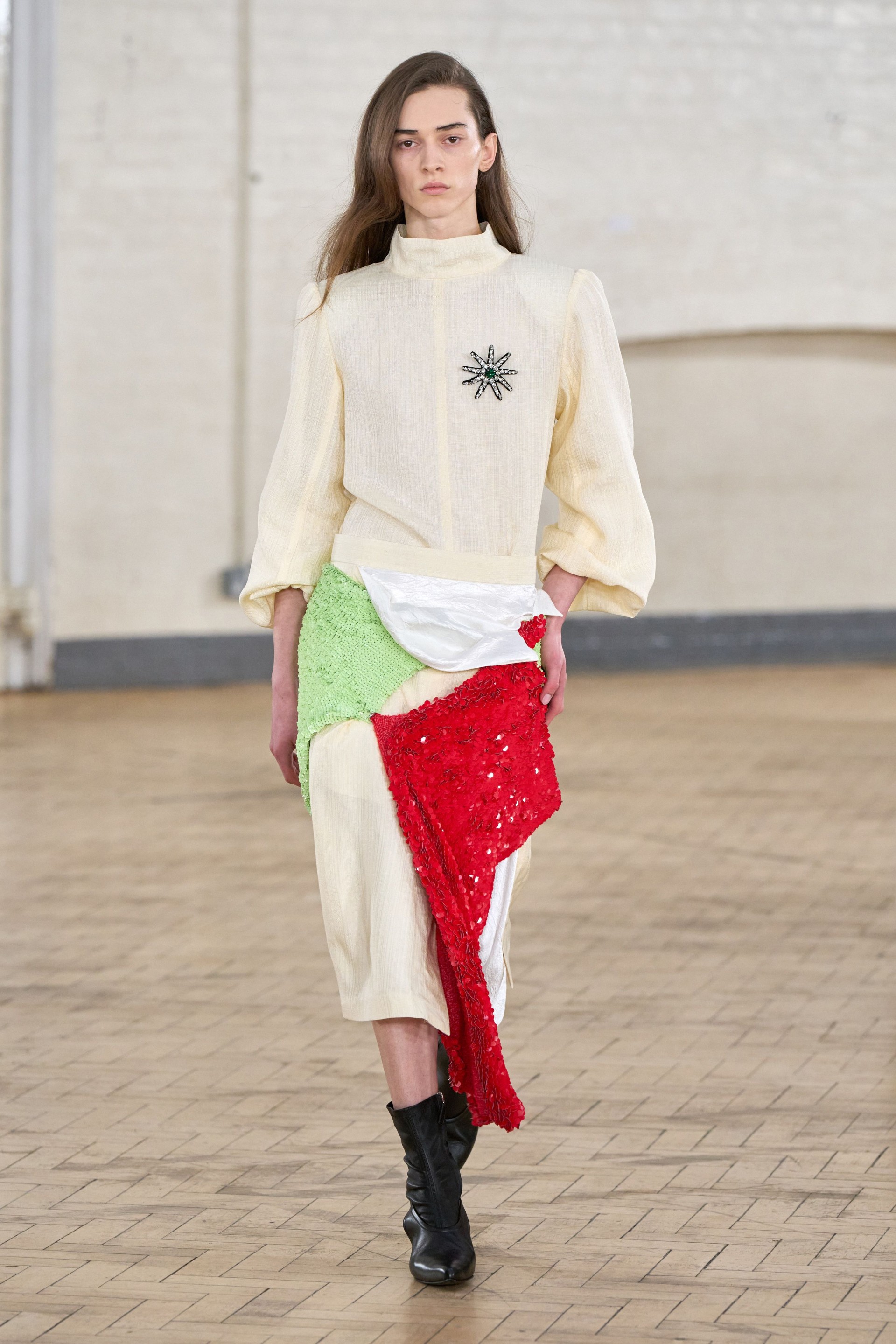
    Much like the Prada show the week prior, this collection also offers a quiet lesson in layering for fall. Looks 36 and 37 present a creased cream cotton dress paired with glittering sneakers, initially styled for a warm day with a bucket hat shielding the wearer from the sun. The same look is then reinterpreted for colder weather with the addition of a fur-lined linen blazer. Beyond functioning as a practical demonstration of layering—a recurring strength of the Prada universe—the pairing also reinforces the idea of the wardrobe as a modular costume, adaptable to the needs of the body it dresses.

    The closing looks move toward sheer, fluid fabrics scattered with jewelled patterning. Here, the relationship between the delicate garments and the raw environment of the Palais d’Iéna—with its grassy ground and furry seating—fully comes into focus. The effect is not quite one of conflict between the designed and the wild, but rather of coexistence. Prada invites us to walk alongside nature, quite literally treading through it in equal parts glitz and glamour.
  • Toga’s Pull, Crumple, Pressed

    Toga’s Pull, Crumple, Pressed

    By Seth Khouri

    The starting point has long been one of fashion’s most seductive revelations—a moment where the designer briefly pulls back the veil. Sometimes it’s explicit, a thesis threaded neatly through each look; at other times it lingers more obliquely, revealed only to those willing to search for it. For Yasuko Furuta, creative director of Toga, that point of departure arrives as a triptych of words. For AW26: Pull. Crumple. Pressed. These verbs read less as instructions and more as tensions—gestures that describe not only fabric, but the body within it. Furuta set out to examine the ways clothing is shaped by pressure: how garments stretch, crease, submit, or resist. In turn, the collection becomes a quiet meditation on adaptation; on whether we, too, bend or hold firm within an ever-accelerating cultural landscape.

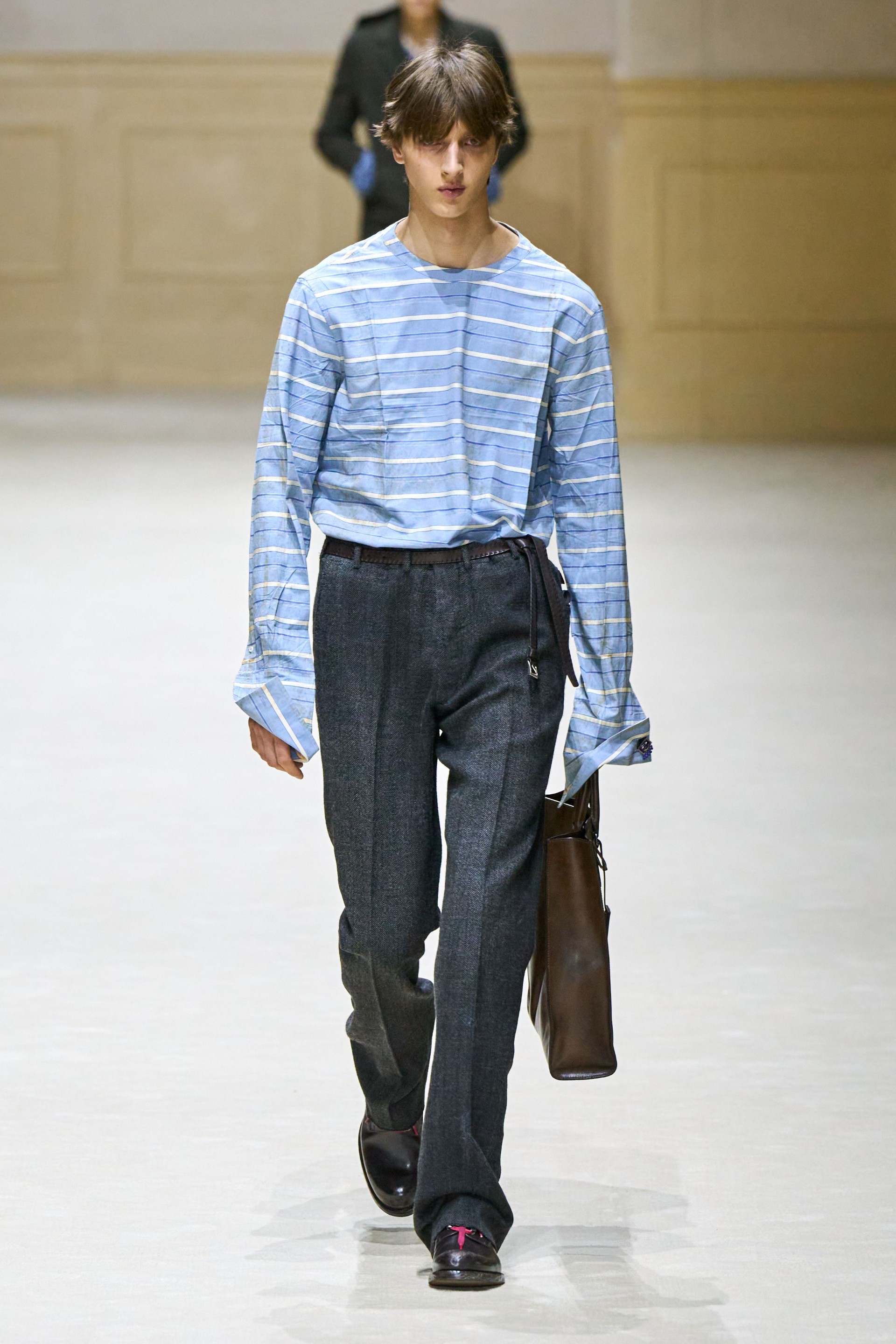
    Across thirty-eight looks, familiar codes were destabilised. Button-downs, fur coats, plaid suiting and billowing trousers formed the backbone, punctuated by flirtatious flashes of sequins and plastic. Look 4 offered a cropped brown fur coat layered over a sky-blue shirt, its right collar jutting outward with deliberate insouciance (a gesture reminiscent of Jonathan Anderson’s recent menswear experiments at Dior). Grey straight-leg wool trousers grounded the look, cinched by a narrow leather belt.

    Styling, as ever with Toga, proved decisive. Leather gloves sharpened silhouettes; shirts were flipped, twisted, and knotted at the waist. There was an intentional undone-ness throughout; cropped suiting trousers punctured with buttons, collars skewed and asymmetrical, hems left hovering in a state of near-disarray. Garments appeared mid-action, as though caught between being pulled and pressed. Colour, too, carried the narrative. While deep winter tones anchored the collection, euphoric flashes of emerald and sky blue cut through with near-optimistic clarity—spring interrupting winter’s stoicism. Look 8 distilled this interplay: a cream long-sleeve shirt crossed with black belts and finished with exaggerated fur cuffs, paired with voluminous white trousers. A cherry-red bag (echoed in the model’s earrings and twin pom-poms perched at each hip) injected a jolt of irreverence.

    In conclusion, Furuta’s AW26 offering does not scream transformation; it studies it. Through subtle distortions and tactile tension, Pull. Crumple. Pressed. becomes less about construction and more about condition; a reflection of garments, and perhaps people, caught between resistance and release.

  • Walter Van Beirendock’s Real Youth

    Walter Van Beirendock’s Real Youth

    By Allanah Davies

    As children, we marvel at the idea of being superheroes and saving the day. We dress up in comic book costumes and play with our toy guns. Walter Van Beirendock’s FW26 may, at first, look like this type of sportive game of heroes and villains–it would not be the first time this iconic Belgian designer sent fantastical toys and creatures down the runway (one only has to think of their SS2008 ‘Sexclown’’ offering). However, like many of his whimsical designs, this offering carries a much harsher meaning beneath the fluorescent surface–this season represents the devastating march of children, fighting against war and destruction with their inefficacious plastic guns. 

    Fashion, nor the arts themselves, are not known for their  ability to enact ceasefires or disarm weapons of war. Yet in a moment when conflict continues to erase homes, histories, and entire childhoods across the globe, Beirendock proposes a different kind of intervention, one that allows us to see the world through the eyes of a child. This FW26, Beirendock blends superhero costume characteristics with real battledress: space-buns with combat shoes, flower embellishments with biohazard symbols, and charm necklaces with nylon military vests. In the disturbing intersection of these modes of dress, Beirendock conjures a child’s attempt to fight against omnipotent army forces. 

    The collection opens with a striking vignette: a boy astride a motorbike fully enveloped in a bright yellow raincoat, extending beyond his body to shield the machine beneath him. The perfectly practical choice is intersected with large plush flower embellishments, suggesting a childlike wonder in the wearer. Moments later, the solitary figure calls for reinforcements  and three armed models come marching behind him in fluorescent uniform. In matching t-shirts and parachute pants, each model has their own colour palette–pink, orange and green–giving the looks a ‘superhero’ like quality. The boys represent their cause by printing it in bold lettering on their t-shirts, they tell us loud and proud that they are fighting “FOR REAL YOUTH.” 

    Accessories emerged as some of the most affecting symbols within the collection, with bags taking on a striking–and emotional–presence. Rendered in the form of backpacks, tophandles and crossbodies, each piece was shaped into playful, creature-like forms complete with cartoonish monster teeth. The reference skewed deliberately away from novelty charm culture; this was less a Labubu bag charm, and more the oversized school backpack of a ten-year-old boy. Created in collaboration with Eastpak, the bags are distinctly childlike, almost like an imaginary friend to these boys, alone in a time of terror. 

    In an interview with ‘What’s Trending Tomorrow,’ Beirendock shares that the collection is “a callout for a better world.” It is a sentiment that resonates far beyond the runway. At its core, the offering imagines a future in which children are granted the luxury of innocence–where toys act simply as tools of joy, not resistance. By filtering the violence of the adult world through a child’s imagination, Beirendock does not dilute its severity; instead the contrast sharpens it. The collection leaves us with a quiet but insistent question: what would it take to build a world where childhood no longer has to double as survival.

  • Prada FW26: Before and Next

    Prada FW26: Before and Next

    By Allanah Davies

    Post-apocalypse, post-pandemic, and post the intellectual rupture ushered in by artificial intelligence, Prada arrives to piece together the relics of a bygone world.  A world filled with dirt, mess, and clothes picked up from the dust. Prada’s Fall Winter 2026 Menswear offering: “Before and Next,” pieces together the relics of an old world, and, in the human interaction with these artifacts intended to dress these awakened bodies, creates “A new silhouette… [that] is conscious of the human form,” thereby creating something distinctly messy, wild and human. 

    For seasons of Prada past, Miuccia Prada and Raf Simons have used their collections to commentate on the overload of algorithms and content that render humanity paralysed in a nonstop stream of stimuli. This season, Simons and Prada awaken that transfixed populace and, guided by “universal human values,” imagine a wardrobe for the incoming winter built entirely by things left by the old world. What they get from this interplay of artefact and artifice is a beautifully practical rotation of sartorial gear: boonie hats in a water resistant nylon, modular trench coats with snap pockets for storage, and understated slim straight leg trouser that quietly accompany every single look in the collection.

    The show was rolled in by the ‘Virgin Prunes’ rebellious post-apocolytic guitar, and, from the ashes, rose the first model, his eyes vacant and hair a mess. He’s rolled up in a black trench coat and those recurring slim suit pants–underneath, a crinkled crew-neck suit shirt that reappears continuously throughout the collection. Yet here, there’s more than meets the eye;  the jacket, covered in soot and soil, illustrates a humanity transfixed in a decaying world, forgetting to wash or dry-clean their designer wardrobe.These imperfections vandalise the otherwise prim and proper archetype Prada is known for, reminding the audience of the imprint our neglect and distraction leaves on the world around us. Indeed, the showspace reinforces this message, the Deposito of the Fondazione Prada is transformed into a derelict collage of anachronistic architecture. Much like the clothes they supplement, the walls are pulled from various styles and periods to create a new look informed by the “collective anterior.”

    Later in the collection, a suite of low cut, feminine tops come sweeping down the runway. At first in the form of knitted scoop neck sweaters in bright yellows and greens, then as straight neck apron tops in whites and pastels reminiscent of last season’s Miu Miu. Is this perhaps the kind of free, feminine expression afforded when the restriction of the old world is gone? Who’s to say. What is certain is Prada’s own assertion: “Either you talk about the world now, or you talk about fashion.” Perhaps then, the less practical, more ornamental pieces signal her insistence on beauty—an element the newly awakened populace chooses to weave into their winter-ready wardrobe. After all, if it is made by human hands, it must contain beauty.

  • Ralph lauren’s mighty menswear return

    Ralph lauren’s mighty menswear return

    By Allanah Davies

    The last time Ralph Lauren appeared on the Men’s Milan fashion week calendar was 2002–a moment when the leisure class and the idea of American identity were read very  differently on the international stage. Today, as perceptions of the American upper class have grown increasingly sour, Ralph Lauren–the brand most synonymous with dressing men who embody the American Dream–returns to  the runway. Not to costume the now villanised man living in inherited ease and beige quarter-zips, but to explore “the different ways men live, their individuality and their personal style,” a sentiment printed on every guest’s seat in the Via San Barnaba headquarters. 

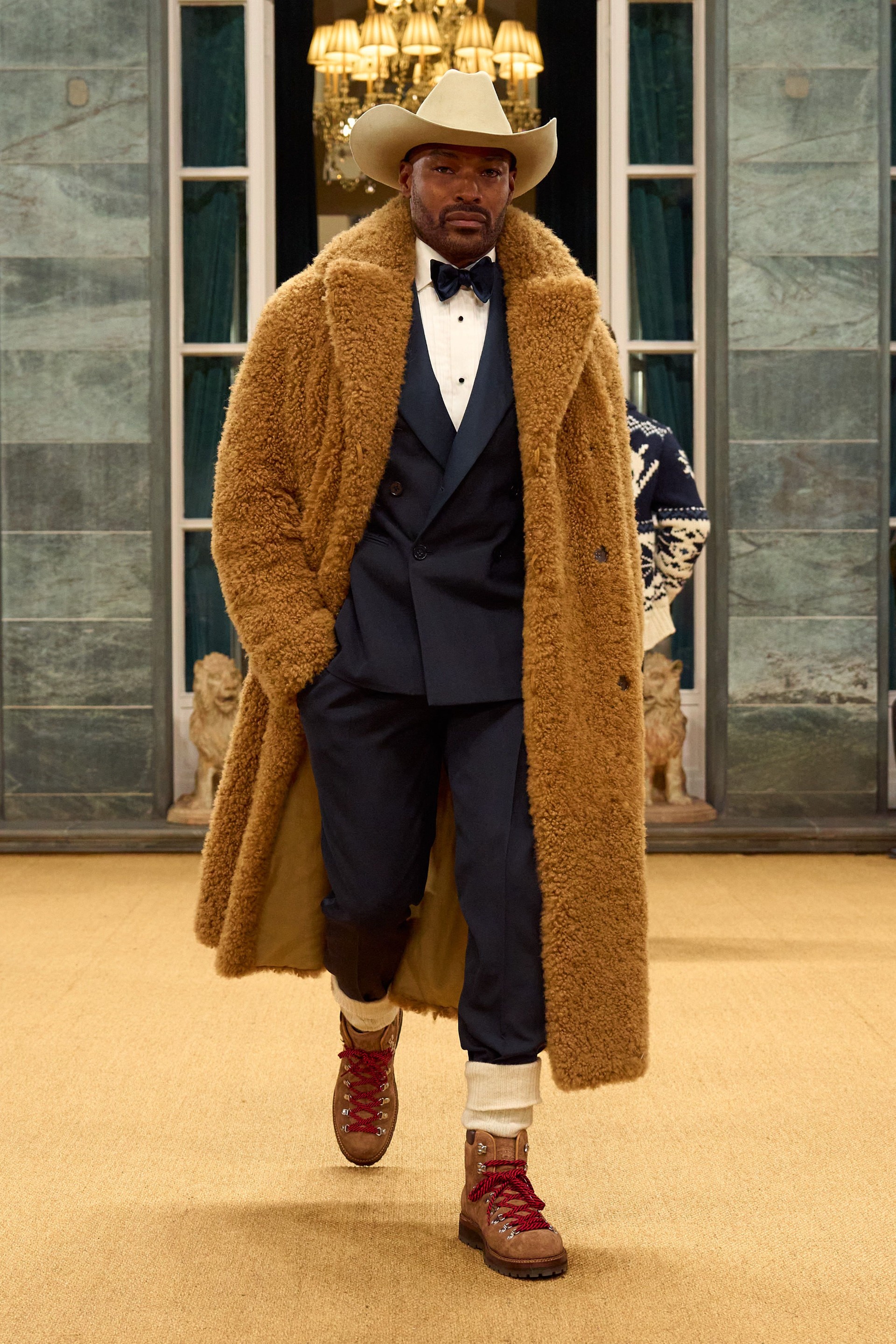
    This season, a palette of earthy purples, greens and oranges painted the opening looks from Lauren’s ‘Polo’ line, and slowly de-saturated towards sophisticated greys and navy’s as the ‘Purple Label’ luxury line was presented. As a comeback collection in menswear, Lauren reminds us of these diverse worlds the Ralph Lauren man occupies, and indeed, reintroduces swagger back to the brand after the suite of beige crepe and linen, quiet luxury yacht-wear that filled last year’s presentations. There was nothing quiet or beige about this season: Lauren splashed together oversized camo-streetwear, Western cowboy hats, corporate suiting and even iconic Polo model Tyson Beckford in a teddy bear coat. As these American archetypal men moved in sequence–NYC Wall Street types in head to toe grey carrying briefcases, hiking enthusiasts leaving for camping trips in camo caps and geometric fleece, and Ivy league students decked out in knitted merchandise and tote bags–Lauren redefines his parameters the American leisure class. As the Ralph Lauren ‘look’ may have been co-opted by a more corrupt ruling class, this season opens the door for youth, creativity and freedom to represent America on the Milanese runway.

    This youthful coolness is displayed most clearly  in the opening looks, the first of which features exaggerated camo pants, paired with the ever so synonymous purple and orange pullover; the kind one inherits from their father; the model’s waist, casually cinched with a puffer jacket, creates a stylized silhouette without trying too hard. The wearer walks with a certain kind of swagger that shows us he’s on the move–whether to a camping trip or simply walking through NYC, that’s your own prerogative.

    If the first half of the collection presented Lauren’s playful approach, the latter illustrated the Ralph Lauren man cleaned up for life back in the city–always keeping his cool, of course. Here, sophisticated tuxedos became the uniform of choice, often accompanied by a touch of “personal style.” Outworked across an embellished biker jacket and yankees cap, or a knitted or teddy bear sweater are worn over the suit to keep the wearer warm and cozy in the formal environments. This new Ralph Lauren man isn’t afraid of colour or showing his own personality even when uniform is preferred and luxury is quietened. 

    Ralph Lauren holds the unique power to redefine American class on the international  stage, and this was the perfect time, and the perfect way, to do so.